








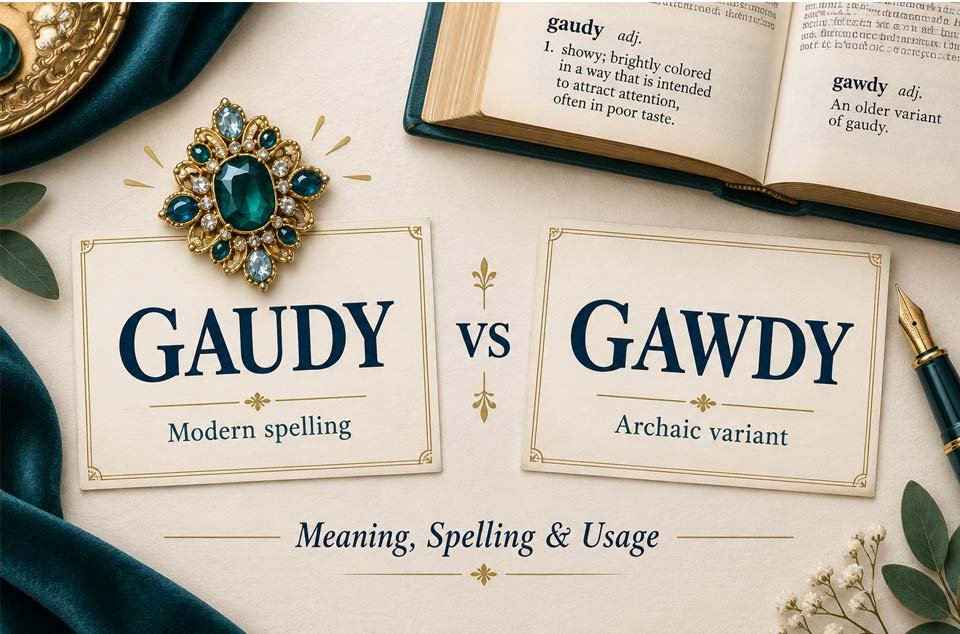
Gaudy vs gawdy has a straightforward answer for modern writing: use “gaudy.” It describes something excessively showy or decorated, usually with a suggestion of poor taste. However, “gawdy” is not simply an invented word. Merriam-Webster records it as an archaic variant of the adjective. Source: Merriam-Webster’s entry for “gawdy”
The distinction is therefore about current usage rather than two separate meanings. This guide explains the difference, provides practical examples, and shows how to choose wording that matches your intended tone.
Gaudy vs Gawdy: A Quick Comparison
| Feature | Gaudy | Gawdy |
|---|---|---|
| Status | Standard modern spelling | Archaic variant |
| Meaning as an adjective | Excessively showy or ornate | Historical variant of the same adjective |
| Suitable for ordinary modern writing? | Yes | Generally avoid |
| Practical use | Describing clothing, decoration, or visual design | Preserving the spelling in an older source |
Writing tip: When composing an email, article, essay, or product description, choose gaudy. When reproducing an older quotation, check the original before changing its spelling.
What Does Gaudy Mean?
Gaudy is an adjective associated with excessive ornamentation, attention-seeking appearance, or tasteless showiness. Merriam-Webster’s definition emphasizes extravagance and decoration that can seem overdone. The word expresses a judgment, not just an observation about color. Calling a jacket bright describes its appearance. Calling it gaudy suggests that its appearance is excessive or unattractive to the speaker.
Compare these original examples:
- Neutral: “The jacket has orange sleeves and a gold collar.”
- Positive: “The jacket’s bold colors give it a lively appearance.”
- Critical: “The jacket looks gaudy with its glittering collar and oversized gold buttons.”
All three sentences could describe the same garment, but they communicate different attitudes.
Is Gawdy Always a Spelling Mistake?
Not in every context. Its dictionary classification as archaic means it has a recognized historical relationship to gaudy. Saying that it has never existed or cannot appear in a dictionary would be inaccurate.
For present-day prose, however, the practical editing choice is straightforward:
- Recommended: “The restaurant’s gaudy entrance distracted from its elegant interior.”
- Revise in modern prose: “The restaurant’s gawdy entrance distracted from its elegant interior.”
Historical quotation requires a different approach. If an original document uses the older spelling, preserve it when quoting faithfully or explain any modernization. Do not silently change a source and present the result as an exact quotation.
How to Use Gaudy in a Sentence
The following examples were written for this guide; they are not quotations from literature or reported events.
Clothing and Accessories
“The enormous jeweled buckle made the otherwise simple belt look gaudy.”
The criticism concerns one decorative feature rather than the entire outfit.
Interior Design
“To Maya, the mirrored ceiling and glitter-covered furniture made the room feel gaudy.”
Attributing the judgment to a person makes its subjective nature clear.
Website Design
“The designer removed the gaudy animated borders so readers could focus on the article.”
For more actionable feedback, explain the specific issue:
“The flashing borders compete with the headline and make the page harder to scan.”
Celebrations and Entertainment
“The deliberately gaudy stage set suited the comedy’s exaggerated style.”
This example shows how an excessive visual style can serve a creative purpose. The surrounding sentence explains why it works in that setting.
Does Gaudy Always Have a Negative Meaning?
In descriptions of appearance, it usually carries criticism. However, Merriam-Webster also records a sense meaning exceptional, such as when the adjective describes impressive performance figures. Context determines which meaning applies.
For everyday communication, consider how your reader will interpret the word. If you intend to compliment someone’s clothing or decorating choices, more direct language may prevent misunderstanding.
Possible alternatives include:
- Colorful when discussing a variety of colors.
- Bold when emphasizing a confident visual choice.
- Decorative when referring to added ornament.
- Eye-catching when focusing on the ability to attract attention.
Choose the alternative that expresses your actual observation rather than substituting words automatically.
Related Word Forms
The standard forms include gaudier, gaudiest, gaudily, and gaudiness.
| Form | Original example |
|---|---|
| Gaudier | “The second invitation was gaudier than the first.” |
| Gaudiest | “They selected the gaudiest costume for the comic character.” |
| Gaudily | “The window was gaudily decorated with metallic ribbons.” |
| Gaudiness | “Removing the flashing lights reduced the display’s gaudiness.” |
A useful spelling reminder is to keep gau- throughout this word family.
Frequently Asked Questions
Which spelling should I use: gaudy or gawdy?
Use gaudy in modern everyday, academic, and professional writing. Reserve the older spelling for contexts where reproducing historical wording is necessary.
Is gawdy a real word?
Merriam-Webster recognizes it as an archaic variant. That makes “historical spelling” a more accurate explanation than claiming it has never been a word.
Does gaudy mean expensive?
No. It describes showiness or excessive decoration, not price. An inexpensive accessory and an expensive furnishing could both attract that description.
Is calling something gaudy rude?
It can sound dismissive because it often criticizes taste. When giving constructive feedback, identify the feature that concerns you, such as competing patterns, excessive ornament, or distracting animation.
Can gaudy describe a website?
Yes. For example: “The gaudy background distracted readers from the text.” In a design review, follow that observation with specific changes that would improve readability.
Are colorful and gaudy interchangeable?
No. Colorful can simply describe appearance, while gaudy normally adds a critical judgment. A colorful design is not automatically excessive or unattractive.
What is the easiest way to remember the spelling?
Remember the consistent beginning in gaudy, gaudier, and gaudiness: all use gau-, without a w.