








The best books for early readers provide enough challenge to help children develop new skills without making reading feel overwhelming. Short sentences, familiar vocabulary, repetition, illustrations, predictable patterns, and engaging stories can all support a child who is learning to read independently.
However, reading ability does not always correspond neatly with age or school grade. Children can progress through reading stages at different rates. Reading development generally moves from recognizing letters and patterns toward decoding words, developing fluency, and eventually understanding increasingly complex text.
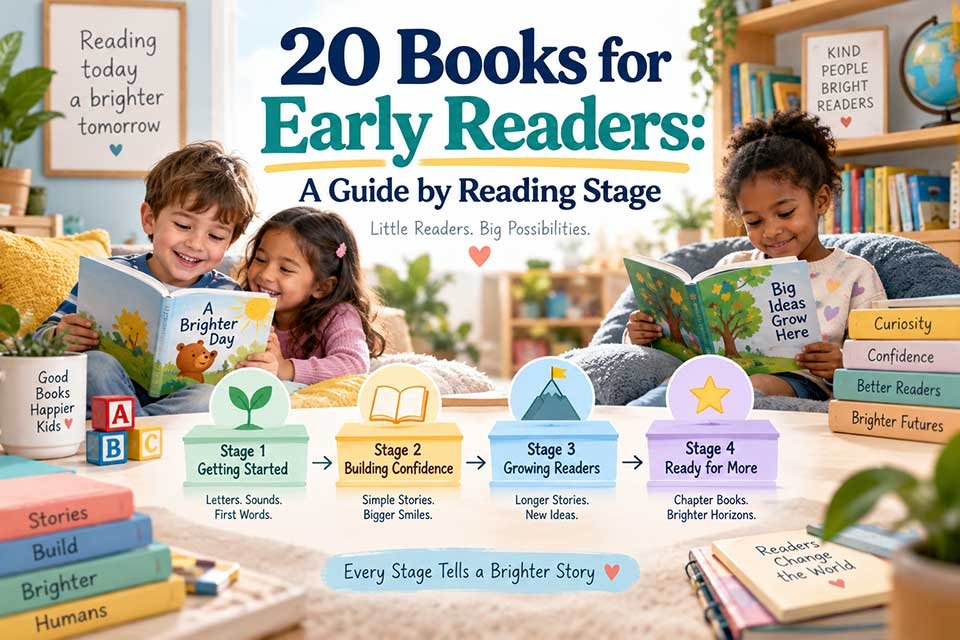
This guide organizes 20 popular children’s books into four practical reading stages:
- Stage 1: Emergent Readers
- Stage 2: Beginning Readers
- Stage 3: Developing Readers
- Stage 4: Early Fluent Readers
The stages below are intended as practical guidance rather than official publisher reading levels.
Quick Comparison: 20 Books for Early Readers
| Book | Suggested Stage | Sentence Complexity | Best For |
|---|---|---|---|
| Brown Bear, Brown Bear, What Do You See? | Emergent | Very simple and repetitive | Pattern recognition |
| Dear Zoo | Emergent | Very short repetitive sentences | Predicting words |
| Goodnight Moon | Emergent | Short rhythmic phrases | Vocabulary and repetition |
| The Very Hungry Caterpillar | Emergent | Short predictable sentences | Sequencing and vocabulary |
| Chicka Chicka Boom Boom | Emergent | Rhyming and repetitive | Alphabet familiarity |
| Go, Dog. Go! | Beginning | Short sentences | Basic vocabulary |
| Hop on Pop | Beginning | Short rhyming phrases | Sound awareness |
| Green Eggs and Ham | Beginning | Repetitive sentences | Reading confidence |
| Biscuit | Beginning | Short simple sentences | First independent reading |
| Pete the Cat: I Love My White Shoes | Beginning | Repetitive conversational text | Confidence and prediction |
| Frog and Toad Are Friends | Developing | Short paragraphs and dialogue | Fluency |
| Little Bear | Developing | Short stories and dialogue | Independent reading |
| Henry and Mudge: The First Book | Developing | Longer sentences | Story comprehension |
| Amelia Bedelia | Developing | More varied sentences | Vocabulary and humor |
| Danny and the Dinosaur | Developing | Short narrative passages | Reading stamina |
| Mercy Watson to the Rescue | Early Fluent | Short chapters | Transitioning to chapter books |
| Nate the Great | Early Fluent | Longer narrative sentences | Comprehension and problem-solving |
| The Princess in Black | Early Fluent | Short chapters | Independent reading |
| Dinosaurs Before Dark | Early Fluent | Chapter-book structure | Reading stamina |
| Eva’s Treetop Festival | Early Fluent | Short chapters and dialogue | Newly independent readers |
Stage 1: Emergent Readers
Emergent readers are beginning to understand how books and printed language work. They may recognize letters, familiar words, repeated phrases, and patterns even before they can independently decode complete sentences.
Reading development research describes emergent readers as benefiting from enjoyable books, repeated readings, pictures, predictable language, and opportunities to connect printed words with spoken language.
1. Brown Bear, Brown Bear, What Do You See?
Author: Bill Martin Jr.
Illustrator: Eric Carle
Suggested stage: Emergent reader
Why It Works
The book uses an extremely predictable sentence pattern that repeats throughout the story. Once children understand the pattern, they can anticipate much of the language on the following pages.
Sentence Complexity
Very low. Most sentences follow essentially the same grammatical structure.
Skills Supported
- Repetition
- Color vocabulary
- Animal vocabulary
- Pattern recognition
- Oral reading confidence
Best For
Children who recognize some letters and words but still depend heavily on illustrations and repetition.
2. Dear Zoo
Author: Rod Campbell
Suggested stage: Emergent reader
A child asks the zoo to send a pet, but each animal presents a different problem.
Why It Works
The repetitive story structure allows children to predict what will happen while learning descriptive words associated with different animals.
Sentence Complexity
Very short sentences and repeated phrases.
Skills Supported
- Prediction
- Animal vocabulary
- Descriptive vocabulary
- Story sequencing
Best For
Children who enjoy interactive books and benefit from repeating familiar phrases.
3. Goodnight Moon
Author: Margaret Wise Brown
Illustrator: Clement Hurd
Suggested stage: Emergent reader
This bedtime classic gradually says goodnight to the objects found around a room.
Why It Works
The recurring language and familiar objects make the text approachable for young learners.
Sentence Complexity
Short phrases with rhythmic language.
Skills Supported
- Object recognition
- Vocabulary
- Rhyming awareness
- Listening skills
- Repetition
Best For
Preschool and kindergarten learners who are beginning to connect spoken words with printed language.
4. The Very Hungry Caterpillar
Author and Illustrator: Eric Carle
Suggested stage: Emergent reader
The story follows a caterpillar eating different foods before eventually becoming a butterfly.
Why It Works
Children encounter repeated sentence structures alongside familiar concepts such as foods, numbers, and days.
Sentence Complexity
Mostly short and predictable sentences.
Skills Supported
- Counting
- Food vocabulary
- Days of the week
- Sequencing
- Predicting
Best For
Children who learn well through pictures, repetition, and chronological stories.
5. Chicka Chicka Boom Boom
Authors: Bill Martin Jr. and John Archambault
Illustrator: Lois Ehlert
Suggested stage: Emergent reader
Letters of the alphabet race one another up a coconut tree in this rhythmic alphabet story.
Why It Works
Its rhythm and repetition encourage children to participate even when they cannot read every word independently.
Sentence Complexity
Short phrases combined with rhyme and repetition.
Skills Supported
- Alphabet recognition
- Letter names
- Rhyming
- Sound awareness
- Reading participation
Best For
Children who are still mastering the alphabet and beginning to understand print.
Stage 2: Beginning Readers
Beginning readers are moving from recognizing patterns toward reading words and short sentences more independently.
At this stage, reading can still sound slow because children are working on decoding individual words. Fluency develops progressively as word recognition becomes easier and more automatic.
These books for early readers offer relatively short text while introducing more opportunities for children to read independently.
6. Go, Dog. Go!
Author: P. D. Eastman
Suggested stage: Beginning reader
Dogs drive cars, climb trees, work, play, and eventually gather for a memorable dog party.
Sentence Complexity
Mostly short sentences with straightforward vocabulary.
Skills Supported
- Common words
- Opposites
- Colors
- Position words
- Sentence reading
Best For
Children beginning to move from memorized patterns toward actual sentence reading.
7. Hop on Pop
Author: Dr. Seuss
Suggested stage: Beginning reader
This wordplay-heavy book introduces children to rhyming word families through short, memorable phrases.
Sentence Complexity
Very short phrases and sentences.
Skills Supported
- Rhyming
- Word families
- Sound recognition
- Vocabulary
- Reading aloud
Best For
Children developing awareness of how changing individual sounds can create different words.
8. Green Eggs and Ham
Author: Dr. Seuss
Suggested stage: Beginning reader
Sam-I-Am repeatedly encourages another character to try green eggs and ham.
Sentence Complexity
Short sentences with extensive repetition, although the sentence structures gradually become longer.
Skills Supported
- Repeated-word recognition
- Reading stamina
- Fluency
- Rhyming
- Expression
Best For
Children who recognize common words and are ready to practice longer stretches of repetitive text.
9. Biscuit
Author: Alyssa Satin Capucilli
Illustrator: Pat Schories
Suggested stage: Beginning reader
Biscuit is a little puppy who is not quite ready to go to sleep.
Sentence Complexity
Short sentences supported heavily by illustrations.
Skills Supported
- Common vocabulary
- Dialogue
- Repetition
- Prediction
- Independent reading
Best For
Children attempting to read an entire simple story independently.
10. Pete the Cat: I Love My White Shoes
Story: Eric Litwin
Art: James Dean
Suggested stage: Beginning reader
Pete’s white shoes repeatedly change color as he steps into different things, but Pete keeps moving along.
Sentence Complexity
Short conversational sentences combined with recurring phrases.
Skills Supported
- Color vocabulary
- Prediction
- Repeated-word recognition
- Reading expression
- Story sequencing
Best For
Children who need an entertaining, low-pressure introduction to independent reading.
Stage 3: Developing Readers
Developing readers can usually handle longer sentences and multiple sentences on a page. They are also beginning to rely less heavily on illustrations.
Repeated reading can help developing readers make word recognition more automatic, allowing more attention to shift toward meaning and comprehension.
11. Frog and Toad Are Friends
Author: Arnold Lobel
Suggested stage: Developing reader
Frog and Toad experience everyday adventures involving friendship, patience, kindness, and humor.
Sentence Complexity
Short paragraphs with frequent dialogue.
Skills Supported
- Fluency
- Dialogue
- Character understanding
- Story comprehension
- Reading expression
Best For
Children who can read basic picture books but are not yet ready for traditional chapter books.
12. Little Bear
Author: Else Holmelund Minarik
Illustrator: Maurice Sendak
Suggested stage: Developing reader
Little Bear experiences a series of gentle adventures with his family and friends.
Sentence Complexity
Short paragraphs, conversational sentences, and dialogue.
Skills Supported
- Reading stamina
- Character comprehension
- Dialogue
- Vocabulary
- Independent reading
Best For
Readers ready to move beyond one or two sentences per page.
13. Henry and Mudge: The First Book
Author: Cynthia Rylant
Illustrator: Suçie Stevenson
Suggested stage: Developing reader
Henry wants a companion and finds one in Mudge, a large and lovable dog.
Sentence Complexity
Longer sentences mixed with short paragraphs.
Skills Supported
- Narrative comprehension
- Character relationships
- Vocabulary
- Reading fluency
- Story sequencing
Best For
Readers becoming comfortable reading several connected paragraphs.
14. Amelia Bedelia
Author: Peggy Parish
Suggested stage: Developing reader
Amelia Bedelia interprets instructions literally, creating humorous misunderstandings as she completes household tasks.
Sentence Complexity
More varied sentences and vocabulary than basic beginner books.
Skills Supported
- Vocabulary
- Idioms
- Context
- Humor
- Reading comprehension
Best For
Children who can decode text comfortably and are beginning to understand that words and expressions can have more than one meaning.
15. Danny and the Dinosaur
Author and Illustrator: Syd Hoff
Suggested stage: Developing reader
Danny meets a dinosaur at a museum and the two spend the day having adventures together.
Sentence Complexity
Straightforward narrative sentences with increasing amounts of text.
Skills Supported
- Story comprehension
- Sequencing
- Vocabulary
- Reading stamina
- Independent reading
Best For
Children who have mastered simple repetitive books and need slightly longer stories.
Stage 4: Early Fluent Readers
Early fluent readers are becoming more automatic in recognizing words. Instead of using most of their attention to decode each word, they can devote increasing attention to characters, events, humor, information, and meaning.
Fluency matters because efficient word recognition helps readers focus more attention on comprehension.
The following books for early readers can help bridge the gap between traditional beginner books and longer children’s chapter books.
16. Mercy Watson to the Rescue
Author: Kate DiCamillo
Illustrator: Chris Van Dusen
Suggested stage: Early fluent reader
Mercy Watson is a food-loving pig whose unusual adventures create plenty of comedy.
Sentence Complexity
Short chapters containing paragraphs, dialogue, and more descriptive language.
Skills Supported
- Chapter reading
- Reading stamina
- Dialogue
- Character development
- Comprehension
Best For
Children attempting their first chapter-style books but who still appreciate frequent illustrations.
17. Nate the Great
Author: Marjorie Weinman Sharmat
Suggested stage: Early fluent reader
Young detective Nate searches for clues to solve everyday mysteries.
Sentence Complexity
Longer narrative passages combined with relatively straightforward vocabulary.
Skills Supported
- Inferencing
- Problem-solving
- Sequencing
- Reading comprehension
- Attention to detail
Best For
Children who enjoy mysteries and are ready to follow a story across multiple chapters or sections.
18. The Princess in Black
Authors: Shannon Hale and Dean Hale
Illustrator: LeUyen Pham
Suggested stage: Early fluent reader
Princess Magnolia has a secret identity: when monsters appear, she becomes the Princess in Black.
Sentence Complexity
Short chapters containing dialogue and increasingly varied sentences.
Skills Supported
- Chapter-book reading
- Character comprehension
- Vocabulary
- Story sequencing
- Reading stamina
Best For
Children ready for their first chapter books but who still benefit from colorful illustrations.
19. Magic Tree House: Dinosaurs Before Dark
Author: Mary Pope Osborne
Suggested stage: Early fluent reader
Jack and Annie discover a mysterious tree house that transports them to the age of dinosaurs.
Sentence Complexity
Full paragraphs and chapter-book storytelling.
Skills Supported
- Reading stamina
- Narrative comprehension
- Vocabulary
- Prediction
- Following multi-chapter plots
Best For
Readers ready to make the transition into traditional children’s chapter books.
20. Owl Diaries: Eva’s Treetop Festival
Author and Illustrator: Rebecca Elliott
Suggested stage: Early fluent reader
Eva Wingdale is an owl who records her activities, friendships, and plans in her diary.
Sentence Complexity
Short chapters with dialogue, diary entries, and accessible paragraphs.
Skills Supported
- Independent reading
- Sequential comprehension
- Diary-style writing
- Vocabulary
- Reading stamina
Best For
Children interested in chapter books but still wanting abundant visual support.
How to Choose the Right Book for an Early Reader
Finding an appropriate book involves more than checking the child’s age.
Reading development occurs along a continuum, and children at the same age can have very different levels of decoding ability, vocabulary, fluency, and comprehension.
Consider these factors.
1. Can the Child Read Most of the Words?
Some unfamiliar words are useful because they create opportunities to practice decoding.
If nearly every sentence contains difficult words, however, the book may currently be too demanding for independent reading.
2. Can the Child Explain What Happened?
Reading the individual words is only part of successful reading.
After a page or section, ask simple questions such as:
- What happened?
- Who was in the story?
- Why did the character do that?
- What do you think happens next?
The answers can help determine whether the child is understanding the text rather than simply pronouncing words.
3. How Complex Are the Sentences?
A useful progression might look like this:
Emergent:
“See the dog.”
Beginning:
“The little dog runs to the red ball.”
Developing:
“The little dog ran across the garden because he wanted to catch the ball.”
Early fluent:
“When Max noticed his favorite ball rolling toward the gate, he raced across the garden to catch it.”
Sentence length, vocabulary, punctuation, and grammatical complexity generally increase as reading ability develops.
4. Are Illustrations Still Needed for Understanding?
Emergent readers often depend heavily on pictures.
Developing readers should gradually become capable of understanding more of a story directly from the text.
5. Is the Child Enjoying the Book?
Interest matters.
A child fascinated by dinosaurs may make a stronger effort to read a slightly challenging dinosaur story than an easier book about a subject that does not interest them.
Why Rereading Is Valuable for Beginning Readers
Parents sometimes worry when children repeatedly choose the same books.
Rereading can actually be useful.
Beginning readers are still working to make decoding and word recognition increasingly automatic. Repeated exposure to familiar text provides opportunities to practice accuracy, phrasing, and expression rather than struggling with completely unfamiliar words every time.
For example:
First reading: Focus on recognizing and decoding words.
Second reading: Read the sentences more smoothly.
Third reading: Practice expression and punctuation.
Fourth reading: Discuss characters, events, and meaning.
The same book can therefore support multiple reading skills.
Simple Weekly Reading Routine for Early Readers
Choosing appropriate books for early readers is only one part of building strong reading habits. Consistent practice is equally important.
Here is a simple routine families can adapt.
| Day | Activity | Main Skill |
|---|---|---|
| Monday | Read a new book together | Decoding |
| Tuesday | Reread the same book | Accuracy |
| Wednesday | Take turns reading pages | Fluency |
| Thursday | Read independently | Confidence |
| Friday | Retell the story | Comprehension |
| Saturday | Choose a favorite book | Motivation |
| Sunday | Visit a library or select next week’s books | Exploration |
The schedule does not need to be rigid. Even short, consistent reading sessions can create opportunities to practice.
Printable Early Reader Book Tracker
Parents and teachers can copy or print this simple tracker.
| Book Title | Date Started | Read Independently? | New Words Learned | My Rating |
|---|---|---|---|---|
| __________________ | __________ | Yes / With Help | ______________ | ⭐⭐⭐⭐⭐ |
| __________________ | __________ | Yes / With Help | ______________ | ⭐⭐⭐⭐⭐ |
| __________________ | __________ | Yes / With Help | ______________ | ⭐⭐⭐⭐⭐ |
| __________________ | __________ | Yes / With Help | ______________ | ⭐⭐⭐⭐⭐ |
| __________________ | __________ | Yes / With Help | ______________ | ⭐⭐⭐⭐⭐ |
| __________________ | __________ | Yes / With Help | ______________ | ⭐⭐⭐⭐⭐ |
| __________________ | __________ | Yes / With Help | ______________ | ⭐⭐⭐⭐⭐ |
| __________________ | __________ | Yes / With Help | ______________ | ⭐⭐⭐⭐⭐ |
| __________________ | __________ | Yes / With Help | ______________ | ⭐⭐⭐⭐⭐ |
| __________________ | __________ | Yes / With Help | ______________ | ⭐⭐⭐⭐⭐ |
Tips for Parents and Teachers
When introducing new books for early readers, focus on progress rather than speed.
A few practical strategies can make reading more productive:
- Allow children enough time to work through unfamiliar words.
- Read difficult sentences aloud when necessary.
- Take turns reading pages.
- Encourage children to point to words while learning.
- Reread favorite books.
- Discuss illustrations before reading.
- Ask simple comprehension questions afterward.
- Introduce unfamiliar vocabulary before beginning a difficult story.
- Model natural phrasing and expression when reading aloud.
- Let children choose books based on their interests.
Reading aloud with a fluent reader can also demonstrate appropriate pacing, expression, and phrasing.
Frequently Asked Questions
What are the best books for early readers?
The best books for early readers depend on the child’s current skills. Emergent readers often benefit from books with repetition and strong picture support, while developing readers may be ready for books such as Frog and Toad Are Friends, Little Bear, or Henry and Mudge. Early fluent readers can begin exploring short chapter books such as Mercy Watson or The Princess in Black.
At what age should a child start reading independently?
There is no single age that applies to every child. Reading development varies, and reading stages are better understood as a continuum of skills rather than rigid age categories. Children typically move from print awareness and letter-sound knowledge toward decoding, fluency, and increasingly sophisticated comprehension.
How do I know whether a book is too difficult?
A book may be too difficult for independent reading if the child struggles with many words on every page, frequently loses the meaning of sentences, becomes frustrated, or cannot explain what happened after reading.
The same book may still work well when read together with an adult.
Should children reread the same books?
Yes. Rereading familiar text can help beginning readers practice word recognition, accuracy, pacing, and expression.
Are picture books only for children who cannot read?
No. Illustrations can support vocabulary, comprehension, prediction, inference, and enjoyment. Some books intended for increasingly independent readers continue to use extensive illustrations while gradually increasing the amount and complexity of text.
Should parents correct every reading mistake?
Not every mistake needs to interrupt the reading experience. If the error changes the meaning or prevents understanding, helping the child decode or supplying a difficult word can keep the story moving. Beginning readers should have opportunities to practice accurately without turning every reading session into a test.
How long should children read each day?
There is no universal amount that fits every child. Consistency and appropriately challenging material are more important than forcing lengthy sessions. Reading Rockets recommends giving beginning readers regular reading time with relatively easy books and opportunities to reread familiar texts.
Final Thoughts
Learning to read develops gradually. A child who currently needs predictable picture books may later progress to short sentences, longer narratives, and eventually independent chapter books.
The goal when selecting books for early readers should therefore not be to find the book with the highest level possible. It should be to find material that allows the child to practice reading successfully while remaining interested in the story.
Start with books that match the child’s current abilities, reread favorites, introduce slightly more challenging material over time, and pay attention to comprehension as well as word recognition.
A book that encourages a child to keep reading is often the most useful book for that particular stage.