








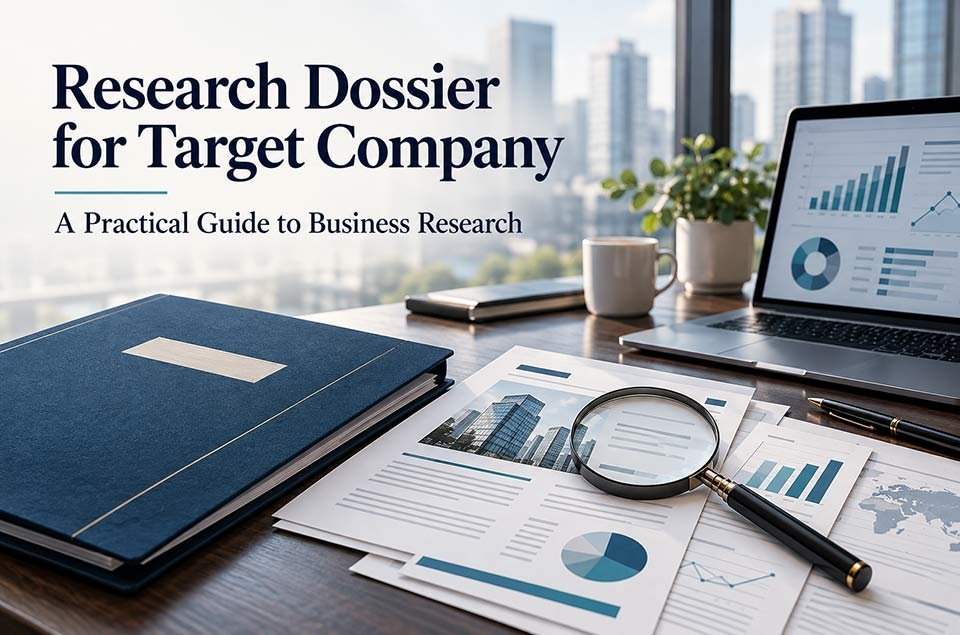
Before approaching a potential client, evaluating a partnership, or preparing for an important meeting, you need a clear understanding of the organization involved. Scattered notes and copied website descriptions rarely provide enough context. A research dossier for a target company brings relevant information into one structured document. It explains what the business does, which developments matter, what the evidence supports, and what still needs investigation.
This guide provides a practical framework for gathering information, assessing its reliability, and turning research into useful next steps.
What Is a Research Dossier for a Target Company?
A company research dossier is an organized collection of facts, sources, observations, and analysis prepared for a specific purpose. It usually covers the company’s identity, products, leadership, market position, recent developments, and relevant opportunities or risks. The depth depends on the decision it supports.
For example, preparation for an introductory sales call may require a short briefing. A potential partnership may need a more detailed assessment of capabilities, operating dependencies, and unanswered questions.
A useful dossier makes three distinctions clear:
- Verified facts: Information supported by identifiable evidence.
- Analysis: An interpretation of what those facts might mean.
- Unknowns: Questions that the available evidence cannot answer.
Keeping these categories separate prevents assumptions from being presented as established information.
Why Prepare a Company Research Dossier?
A research dossier for target company gives everyone involved a shared starting point. It helps teams avoid repeating basic research and makes it easier to understand the reasoning behind a proposed action.
Its purpose should shape its contents.
|
Research Purpose |
Main Questions |
| Sales preparation | Does the company fit our offering, and what should we ask during discovery? |
| Partnership evaluation | Are our capabilities, priorities, and operating expectations compatible? |
| Competitor analysis | Where do our products, audiences, and positioning overlap? |
| Supplier assessment | What evidence supports the supplier’s ability to meet our requirements? |
| Interview preparation | What does the company do, and how does the role support its priorities? |
Define the intended decision before collecting information. Otherwise, research can become a lengthy company history with little practical value.
What Should the Dossier Include?
The strongest research dossier for a target company focuses on information that supports its purpose. Use the following sections as a starting structure.
-
Executive Summary
Write a short overview of the most important findings:
- What the company does.
- Why it is relevant to your objective.
- Which developments deserve attention.
- What remains uncertain.
- What action you recommend next.
Prepare this section after completing the research so that it reflects the evidence.
-
Company Identity and Background
Record the legal name, trading name, official website, headquarters, operating locations, and relevant ownership information. Check that all sources refer to the same entity. A brand, parent company, and subsidiary may have different responsibilities, leadership teams, and financial records. Where available, record a registration number or another reliable identifier to reduce confusion between businesses with similar names.
-
Products, Services, and Customers
Explain what the business sells, which problems it addresses, and whom it serves. Use product documentation, service descriptions, customer case studies, and published pricing where relevant. Identify whether customer examples represent current relationships, historical projects, or company marketing claims. Avoid inferring the entire customer base from a few logos on a website.
-
Leadership and Relevant Stakeholders
Identify professional roles connected to your research objective. For a technology proposal, relevant stakeholders might include operational leaders, technical evaluators, procurement staff, and budget owners. Their involvement should be confirmed through conversation rather than assumed from job titles alone. Include relevant professional information and record when roles were last checked.
-
Business Performance and Recent Developments
Capture financial information when it is available and relevant. State the reporting period, currency, entity, and source. Distinguish revenue from funding, profit from cash flow, and reported results from estimates. If a private company does not disclose a figure, label it unavailable. Recent developments may include product launches, new locations, acquisitions, leadership changes, or hiring activity. Explain their possible relevance without assuming they prove a particular business need.
-
Market Position, Opportunities, and Risks
Compare the company with relevant alternatives using consistent criteria. For example, compare customer segments, product scope, service coverage, pricing structure, or distribution channels. Avoid unsupported descriptions such as “industry leader” or “fastest-growing provider.” For each opportunity or risk, explain the supporting evidence and the question that would help validate your interpretation.
How to Build a Research Dossier for Target Company
Step 1: Define the Research Question
Write one sentence describing the decision you want to support.
For example:
Determine whether this company is a suitable prospect for our customer service software and identify the questions to ask during an initial meeting. Set boundaries around geography, business unit, and time period.
Step 2: Gather Relevant Sources
Start with material directly connected to the business:
- Official company pages and product documentation.
- Published reports and applicable company filings.
- Leadership announcements and recruitment pages.
- Customer case studies and public presentations.
Use independent reporting and specialist sources to add context. Remember that an official company announcement can confirm what the company says, but its promotional interpretation may still need scrutiny.
Step 3: Maintain an Evidence Log
Record each meaningful finding alongside its source and date.
| Field |
What to Record |
| Finding | The specific fact or claim |
| Source | Document title, publisher, and location |
| Timing | Publication date and relevant reporting period |
| Evidence status | Confirmed, company-reported, estimated, or unresolved |
| Relevance | Why the finding matters |
| Follow-up | What should be checked next |
When sources disagree, preserve the discrepancy until you can explain it. Do not quietly choose the figure that best supports your preferred conclusion.
Step 4: Convert Findings Into Questions
Research becomes useful when it helps you prepare better questions. A company advertising several customer support vacancies may be increasing capacity, replacing employees, or restructuring its service model. The vacancies alone do not establish which explanation is correct.
A suitable follow-up might be:
How are your support requirements changing, and where does your current process create the most work?
Step 5: Review and Assign Ownership
Before sharing the document, check names, dates, figures, and source references. Assign someone to maintain it, record the latest review date, and identify events that should trigger an update. Important changes may include a new executive, revised product offering, or newly published results.
Research Dossier for Target Company: Practical Template
Use this outline to keep the document consistent and easy to review.
| Section |
Suggested Content |
| Document details | Company, purpose, author, scope, and review date |
| Executive summary | Key findings, uncertainties, and next action |
| Company profile | Identity, ownership, locations, and background |
| Commercial overview | Products, customers, and business model |
| Stakeholder overview | Relevant professional roles and responsibilities |
| Recent developments | Dated announcements and changes |
| Competitive context | Comparisons based on relevant criteria |
| Opportunities and risks | Evidence, interpretation, and validation questions |
| Research gaps | Missing or conflicting information |
| Source register | References supporting the findings |
Add an appendix for detailed evidence so the main document remains focused.
Worked Example: Preparing for a Sales Meeting
Consider a fictional software provider researching a retail business that has announced two additional stores and advertised customer service positions. Its research dossier for target company could record the findings as follows:
| Evidence | Possible Interpretation |
Question to Validate It |
| Announcement of two additional stores | The operating footprint is expanding | Will the new stores use the same support processes? |
| Advertised customer service vacancies | Staffing requirements may be changing | Are these new roles or replacements? |
| Website lists several contact channels | Customer inquiries arrive through multiple routes | How does the team manage conversations across channels? |
The evidence supports a discovery conversation. It does not establish that the retailer has a service problem, an approved software budget, or an intention to replace its current system. The recommended next step would be to explore those questions before preparing a proposal.
Common Research Mistakes to Avoid
A research dossier for target company loses value when information is collected without careful interpretation.
Common mistakes include:
- Mixing entities: Using a parent company’s results to describe a subsidiary.
- Ignoring dates: Treating an old announcement as a current priority.
- Overstating signals: Assuming hiring activity proves growth or purchasing intent.
- Copying promotional language: Repeating claims without attribution.
- Inventing missing figures: Filling gaps with unsupported estimates.
- Recording facts without purpose: Adding detail that does not affect the decision.
If you use AI to organize notes or draft summaries, verify the output against the original material. Keep source references intact and check that the summary preserves qualifications and uncertainty.
Frequently Asked Questions
How Long Should a Research Dossier for Target Company Be?
Its length should match the decision and available evidence. An introductory meeting may need a concise briefing, while a more complex evaluation may require supporting analysis and appendices. Include the detail readers need to assess your conclusions.
How Often Should It Be Updated?
Review it before important meetings or decisions and after significant company developments. Assign a review schedule that reflects how quickly the relevant information changes.
Can It Be Created Using Public Information?
Yes. Public information can support useful preliminary research. Clearly identify gaps that require direct questions or authorized access to additional documents.
How Is It Different From a Company Profile?
A profile primarily describes the business. A dossier connects information to a defined objective, evaluates evidence, identifies uncertainties, and recommends next steps.
Conclusion
An effective research dossier for target company makes business research easier to assess and act on. Its value comes from relevant evidence, transparent reasoning, and clear questions. Begin with a defined objective, document your sources, separate facts from interpretations, and finish with an action that the evidence supports.